
Early Reading
At Coleshill, strong foundations in early reading are non‑negotiable. We teach a rigorous, systematic synthetic phonics (SSP) programme with clear progression, daily practice, fully‑decodable books and precise assessment so that every child secures accurate decoding, fluency and confidence as soon as possible.
We use Sound!Start Phonics to teach GPC knowledge, blending for reading and segmenting for spelling through a consistent review → teach → practise → apply cycle, beginning with Nursery, moving into Reception, then into Year 1 and beyond where needed. Pupils read fully decodable texts matched to taught code and apply their phonics across the curriculum—cementing those strong foundations.
Vibrant
Early reading at Coleshill is vibrant: lessons are pacey, purposeful and joyful, with daily opportunities to read, re‑read and succeed. Our SSP progression from Phase 1 oral skills through the basic and complex code keeps learning ambitious and engaging, while fully decodable books ensure children experience immediate success and enjoyment—key drivers of motivation highlighted by the Reading Framework.
- Daily routines (review→teach→practise→apply) maximise active participation and rapid feedback, building accuracy and fluency.
- Decodable books are carefully matched to taught GPCs so practice is successful and confidence grows.
Rooted
Our early reading approach is rooted in our Christian vision, where every child is known, loved and encouraged to flourish. We want all children to feel confident and successful as they learn to read, and we build those strong foundations using the very best research about how reading develops.
We focus on the things that matter most for early reading:
- learning letter–sound relationships (GPCs) accurately
- blending sounds to read words
- segmenting words to spell
By keeping lessons clear and consistent—without extra actions or distractions—children quickly become confident, independent readers and writers
Connected
Our early reading is connected—within lessons, across phases and into the wider curriculum.
- The Sound!Start progression is cumulative and coherent (Reception → Y1 advanced code), connecting prior knowledge to new learning and linking reading and spelling while teaching each process explicitly.
- Application is planned beyond phonics: guided reading with fully decodable texts, teacher‑led writing and regular opportunities to read across subjects, in line with the Reading Framework’s emphasis on practice and application.
Inclusive
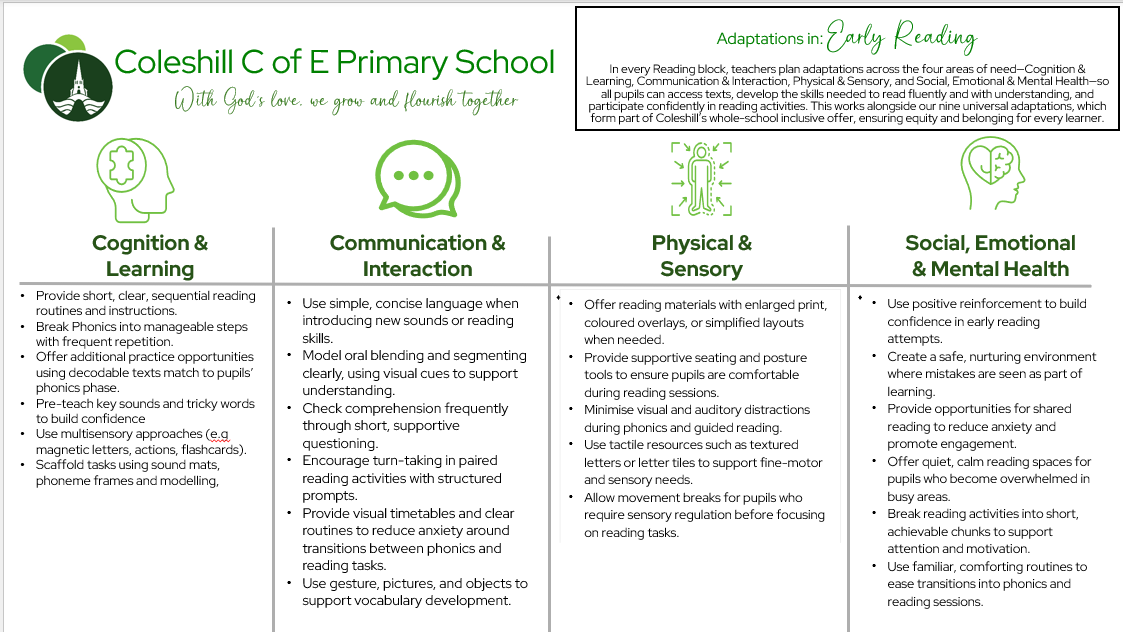
Our early reading is inclusive by design so every child secures those strong foundations.
- Every lesson builds in guided and independent practice, with scaffolds and differentiation so pupils with SEND and those needing ‘keep‑up’ have equitable access to success.
- Consistency, repetition and small‑step progression reduce cognitive load and are especially supportive for pupils who need the most help—reflecting the Reading Framework’s guidance on keep‑up/catch‑up
Adaptations in Early Reading