

Collective Worship
Proud to be a Church of England School
All staff and Governors are committed to making our school a place where Christian love, hope, and a strong sense of belonging are lived out each day. Through our actions and relationships, we seek to create a nurturing environment where every member of our community feels valued, supported, and inspired. Our Christian vision underpins everything we do, enabling us to make a meaningful contribution to community cohesion and to promote a more equitable and tolerant society.
The Christian ethos of the school, and the values for which we stand, are evident in every aspect of school life. While we are rooted in our Christian foundation, we warmly welcome and respect those of all faiths and none, fostering an inclusive and caring community.
Religious Education plays an important role within our curriculum. We have strong links with our parish church, St Peter and St Paul’s, and we enrich our pupils’ understanding through visits to a variety of places of worship.
Worship at our school
Each day children have the opportunity to take part in collective worship which is broadly Christian in character. Although the school is a Birmingham Diocese Church of England school, the beliefs and customs of other religions are respected and valued and children from other faiths are welcome in the school.
Collective worship is usually held in the hall, and is led by a visitor, a teacher, Reverend Sarah Tillett (Vicar at Coleshill Parish Church) or children from the school. The Bible group lead collective worship once a week. A hymn or song is sung and prayers are said. We often have a Bible story or look at a topic from the news which we can think more about. It is a time to reflect together upon the Bible and life in our Church of England school. Each week of the year has a different collective worship theme. Collective worship usually takes place in class once a week where together the class teacher and the children lead and participate in the collective worship.
Christian Values
Our worship reflects the core values arising from our vision:
- Love (expressed through kindness and forgiveness)
- Hope (perseverance and self-control)
- Belonging (respect and honesty)
These values are rooted in scripture and underpin all aspects of worship and school life.
Legal Requirements
Collective worship is invitational, inclusive and reflective, never coercive.
Aims
Through collective worship we aim to:
- Foster awe and wonder in God’s creation
- Develop understanding of love, hope and belonging
- Explore meaning, purpose and big questions
- Promote reflection and stillness
- Encourage courageous advocacy and service
- Strengthen community and relationships
The Act of Collective Worship
Collective worship at Coleshill C of E Primary School is invitational, inclusive and inspirational.
We structure worship using our Spirituality Policy framework:
- Windows – looking out at the world with awe and wonder
- Mirrors – reflecting on ourselves and our lives
- Doors – responding with action and making a difference
We explicitly use the shared language of:
- WOWs – awe and joy
- OWs – challenge and difficulty
- NOWs – stillness and reflection
This enables pupils to understand spirituality as part of everyday life and growth.
Prayer is invitational and inclusive, allowing all pupils to engage at their own level.
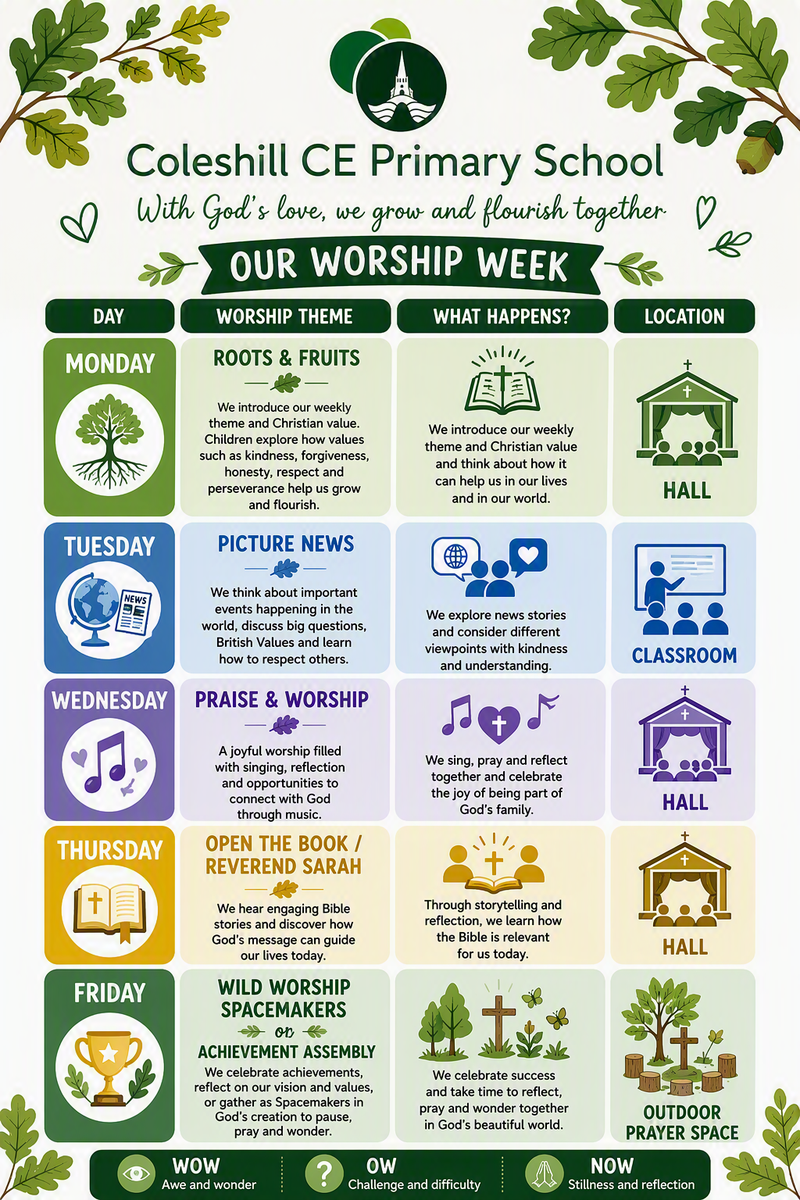
| Monday | Tuesday | Wednesday | Thursday | Friday |
| Roots and Fruits | Picture News or Wild Worship | Praise and Worship (Singing) | Open the Book or Reverend‑led Worship (Bi‑weekly) | Celebration Worship |
| Roots and Fruits worship introduces the weekly theme through the lens of the school’s Christian vision, exploring its biblical roots and meaning. Pupils are invited to reflect on how these values bear fruit in their own lives, supporting spiritual growth and lived faith. | This worship connects Christian values to nature and the wider world through music, images, and current events in an inclusive and age‑appropriate way. Pupils are encouraged to reflect, question, and respond, developing moral awareness and compassionate understanding. | Praise and worship through singing is inspirational and joyful, enabling pupils to participate actively in a shared expression of faith. It nurtures spirituality, a sense of belonging, and familiarity with Christian language and worship practices. | These acts of worship engage pupils with Bible stories and Christian teaching in ways that are accessible, memorable, and invitational. Clergy involvement sstrengthens the school’s relationship with the local church and deepens pupils’ understanding of Christian tradition. | Celebration worship affirms pupils’ achievements and positive behaviour, recognising the dignity and worth of every individual. It revisits the weekly Christian theme, helping pupils see how values are lived out within the school community. |
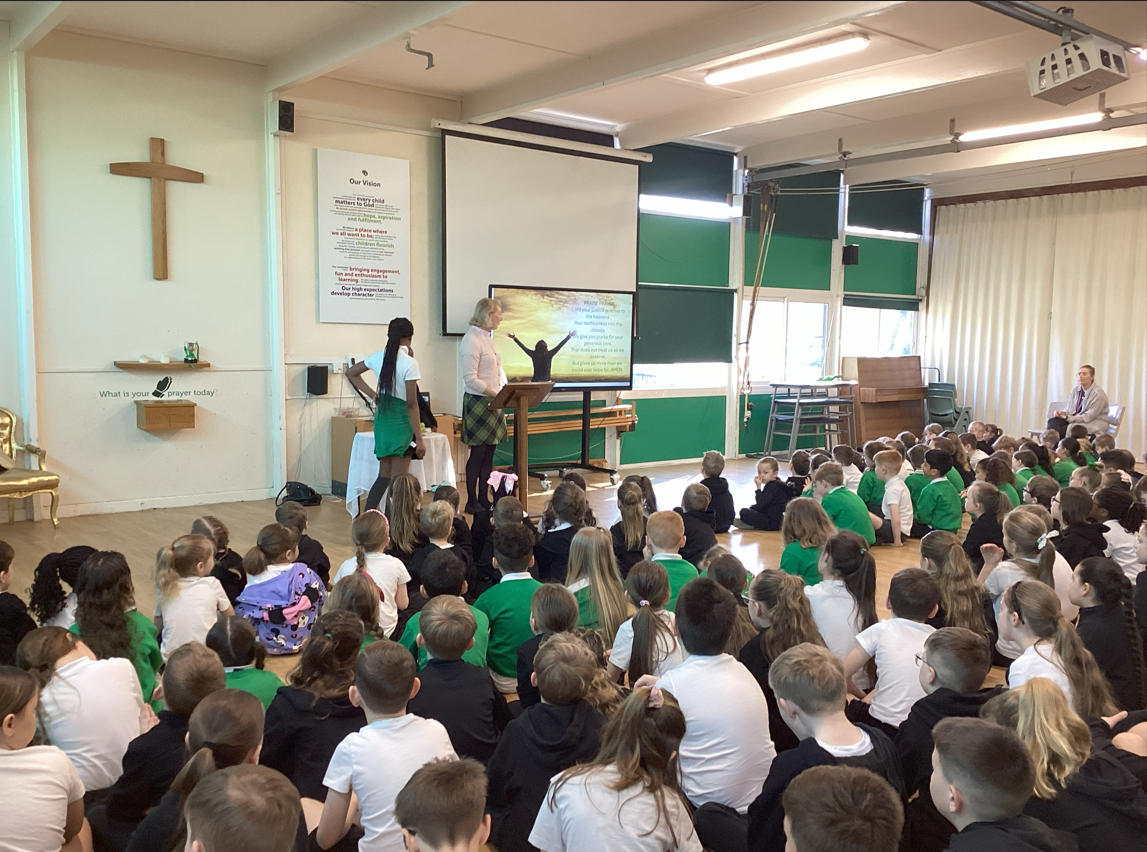
Collective Worship: Reflection and Response
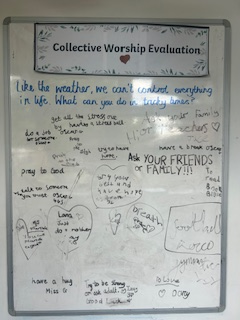
Our approach to collective worship is deeply rooted in enabling pupils to reflect meaningfully and respond in ways that shape their daily lives. Each week, we use a dedicated Collective Worship Reflection Board as a visible and evolving record of pupils’ thoughts, responses and commitments following worship.
After participating in worship, children are given time and space to consider the key message and how it applies to them personally. They then contribute to the reflection board, sharing how they intend to live out the values explored. These responses may include written reflections, drawings, prayers, or symbolic representations, allowing all pupils to express themselves in ways that are authentic and inclusive.
A central strength of this practice is the autonomy given to pupils. Children take ownership of the board, independently deciding what to include and how to present their ideas. This encourages genuine engagement, rather than compliance, and ensures that responses are heartfelt and relevant. As a result, the board becomes a powerful pupil-led display of spiritual development in action.
The reflections consistently demonstrate pupils’ growing ability to think deeply, make connections and consider the impact of their actions on others. Responses often reflect a commitment to positive change, such as showing greater kindness, forgiveness, courage or respect in the week ahead. In this way, collective worship moves beyond a standalone experience and becomes a catalyst for lived-out Christian values across the school community.
The board also serves as a shared space for ongoing reflection. Pupils revisit it throughout the week, reinforcing the message of worship and celebrating the ways in which individuals and groups are striving to make a difference. This promotes a culture of accountability, encouragement and spiritual growth.
Overall, the Collective Worship Reflection Board is an effective and meaningful tool in embedding the impact of worship. It ensures that pupils not only engage thoughtfully with worship but are inspired to translate reflection into action, supporting the school’s vision and values at every level.
Here are songs we are currently loving singing in our Praise and Worship time.