

Attendance
At our school, we believe that every day matters. Regular attendance and good punctuality help children feel settled, confident and ready to enjoy learning with their friends. We work hard to ensure that every child feels loved, valued and that they truly belong here, so that coming to school each day is something to look forward to.
Celebrating Good Attendance
We celebrate good attendance positively: children earn praise points each week, and in our achievement assembly we recognise the class with the best attendance. That class enjoys a special treat of cookies at playtime, a joyful way to say well done! By celebrating attendance in this way, we encourage a positive start to each day and help every child build happy routines that support their wellbeing and success.
Collective Worship: We hold a weekly Achievement Assembly and as part of this celebration, we recognise the class with the best attendance. This reward is very looked forward to, as the winning class have fresh baked cookies at playtime!
Attendance Awards: At the end of each term we have a special Attendance Assembly where we celebrate all the children who have achieved 100% attendance for that term.
At the end of the year, we celebrate all the children that have managed to achieve 100% attendance and they receive a special badge to wear all through the year. Many of our children have achieved bronze, silver and gold awards.
The Emily Hodges Award: In honour of Emily Hodges, who during her time from Reception to Year 6 never missed a single day of school, we now have the Emily Hodges Attendance Shield. Year 6 children who have achieved the best attendance during their education at our school in their year group, will be honoured with their name being added to the shield. This is a very special achievement to be celebrated.
Working together to Improve School Attendance
Attending school regularly and on time has a positive impact on learning, progress and therefore the best life chances for pupils. Research shows that attendance and punctuality are important factors in school success. At Coleshill C of E Primary School we expect all children to achieve attendance that is at least 96%.
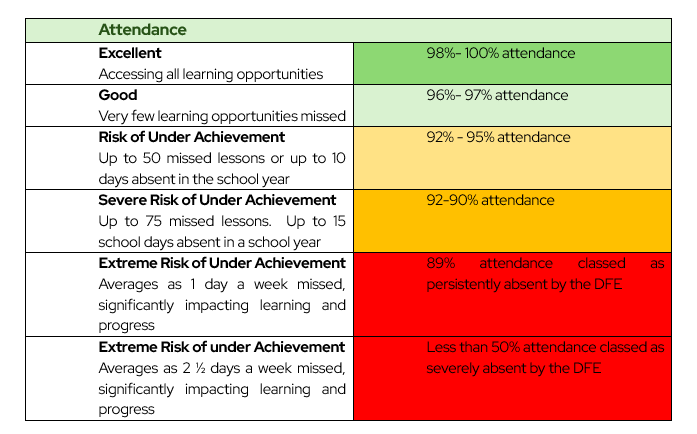
As stated in the DfE document ‘Working Together To Improve School Attendance’, school will
Expect – Aspire to high standards of attendance from all pupils and parents and build a culture where all can, and want to, be in school and ready to learn by prioritising attendance improvement across the school.
Monitor – Rigorously use attendance data to identify patterns of poor attendance (at individual and cohort level) as soon as possible so all parties can work together to resolve them before they become entrenched.
Listen and understand – When a pattern is spotted, discuss with pupils and parents to listen to and understand barriers to attendance and agree how all partners can work together to resolve them.
Facilitate support – Remove barriers in school and help pupils and parents to access the support they need to overcome the barriers outside of school. This might include an early help or whole family plan where absence is a symptom of wider issues.
Formalise support – Where absence persists and voluntary support is not working or not being engaged with, partners should work together to explain the consequences clearly and ensure support is also in place to enable families to respond. Depending on the circumstances this may include formalising support through an attendance contract or education supervision order.
Enforce – Where all other avenues have been exhausted and support is not working or not being engaged with, enforce attendance through statutory intervention: a penalty notice in line with the National Framework or prosecution to protect the pupil’s right to an education.
Improving Attendance:
- Early Intervention: Our staff closely monitor attendance data and identify students who may be at risk of falling behind. We proactively reach out to these families to provide support and address any issues that may be affecting attendance.
- Parent Communication: We maintain open lines of communication with parents regarding their child’s attendance. Regular updates and reminders about the importance of attendance are sent via newsletters and emails.
Attendance Partnership Expectations 
We expect the following from all of our pupils:
- To attend school regularly.
- To arrive on time and appropriately prepared for the day, having eaten breakfast or attend breakfast club;
- To talk to a member of staff about any problem or reason that may prevent them from attending school.
We expect the following from parents and carers:
- To ensure their children attend school regularly and punctually;
- To ensure contact is made with school, as soon as is reasonably practical, whenever their child is unable to attend;
- To ensure that their children arrive in school well prepared for the school day, having eaten breakfast. If this is difficult, then please talk to us so we can support you.
- To talk to a member of school staff about any problem or reason that may prevent them from attending school.
Parents and pupils can expect the following from school:
- Early contact with parents when a pupil fails to attend school without providing a good reason
- Regular, efficient and accurate recording of attendance
- To inform parents if a pupil’s attendance falls below expected levels
- To listen and understand the barriers to school attendance and offer appropriate support and agree appropriate plans to improve attendance.
- Follow up support if needed.
Reporting Absence
All absences should be reported to school as soon as possible. Please call 01675 463672 to report an absence.
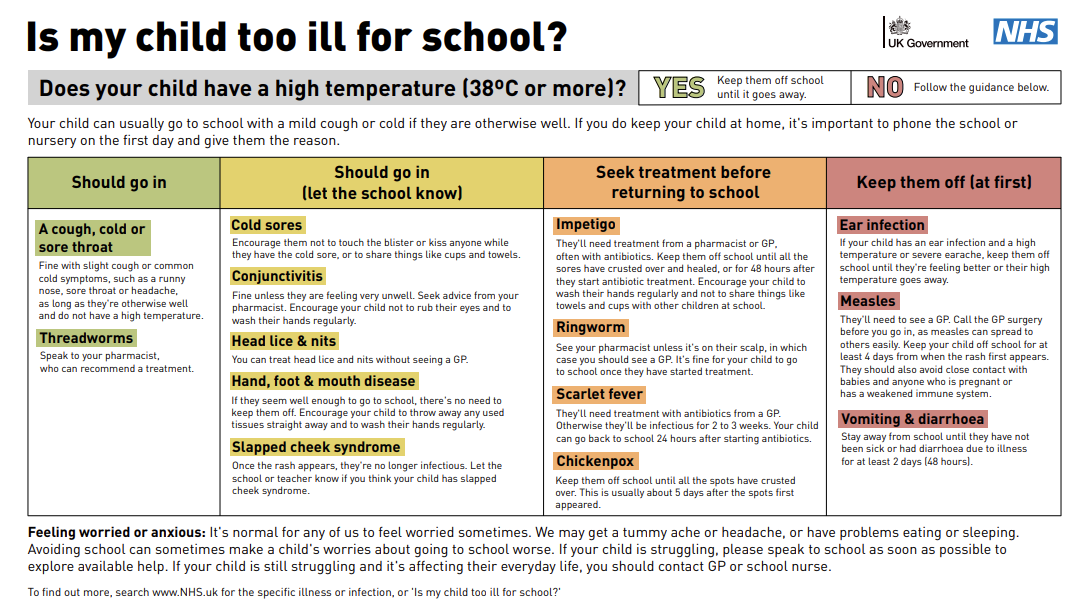
Where the illness is vomiting and/or diarrhoea, please keep your child off school for 48 hours after the last symptoms.
Is my child Too Ill for School?
It can be tricky deciding whether or not to keep your child off school or nursery. Please see the link for NHS guidelines. Please be assured that if we feel your child is too ill to be in school, we will call you to let you know.
https://www.nhs.uk/live-well/is-my-child-too-ill-for-school
If your child is feeling anxious about coming to school please do talk to your child’s class teacher. We have a pastoral team who can support you and your child. If your child’s anxiety is starting to affect their wellbeing, they may need some help. Please see the NHS link for further information https://www.nhs.uk/mental-health/children-and-young-adults/advice-for-parents/anxiety-in-children/
My child is Struggling to come to school
We understand that coming to school can sometimes be difficult for children. If your child is struggling to attend, whether for emotional, health or practical reasons, please contact us early so we can work together to understand and address the barriers. We will listen, offer support, and agree a plan with you to help your child feel safe, supported and ready to learn.
Class teachers are happy to talk to you about any attendance barriers, and if we notice that your child’s attendance is starting to dip, we will call you to find out if there is anything we can do to support.
https://www.warwickshire.gov.uk/school-attendance/school-attendance-guidance-parentscarers/5
Holidays in Term Time
We understand how valuable family time is and how important breaks and holidays can be. However, government regulations mean that headteachers are not permitted to authorise holidays during term time, except in very limited and exceptional circumstances.
Time away from school can have a significant impact on children’s learning, friendships, routines and sense of belonging. Every school day provides important opportunities for progress, confidence-building and shared experiences that cannot easily be replaced.
We kindly ask families to plan holidays during school holiday periods wherever possible. This helps us ensure that all children can benefit fully from the learning, care and community life of the school.
If you are experiencing particular circumstances or need support, please talk to us. We are always happy to listen and work in partnership with families to do what is best for your child.
Leave of Absence
Leave of Absence
- The law states a leave of absence may only be granted by a school if an application is made in advance and if it considers there are exceptional circumstances relating to the application.
Expectations
- A leave of absence is granted entirely at the school’s discretion. Permission for a Leave of Absence from a school may only be given by a person who the school’s proprietor has authorised to do so (an authorised person).
- Schools must judge each application individually considering the specific facts and circumstances and relevant background context behind each request.
- Generally, a need or desire for a holiday or other absence for the purpose of leisure and recreation would not constitute an exceptional circumstance.
- Where a leave of absence is granted, the school will determine the number of days a pupil can be absent from school.
- When making an application for Leave of Absence parents are advised to give sufficient information and time to allow the Head teacher the opportunity to consider all the exceptional circumstances and to notify the parents of their decision. The school may also request further information on the application and supporting documentation where appropriate.
- It is advised that if the resident parent has not received notification or a response regarding the leave of absence application, it is their responsibility to ascertain if the leave is authorised prior to the start of the leave.
- The school can only consider applications for Leave of Absence which are made by the resident parent. i.e the parent with whom the child normally resides.
- Where applications for Leave of Absences are made in advance and refused, the child is expected to be in school on the dates set out in the application. If the child is absent during that period, it will be recorded as an “unauthorised” absence. Where a leave of absence is requested but additional days take either prior to or after the request, they may be considered as part of the leave of absence.
- Leave of Absences which are not made in advance cannot be authorised in line with legislation. This will result in the absence being recorded as ‘unauthorised’.
- All matters of unauthorised absence relating to a Leave of Absence will be referred to the Warwickshire Attendance Service of Warwickshire County Council. Penalty notices are issued in accordance with Warwickshire County Council’s Code of Conduct for Penalty Notices and in the first instance, as an alternative to prosecution proceedings.
- Where a Penalty Notice is not paid within the timeframe set out in that Notice, the matter will be referred to Warwickshire County Council’s Legal Services to consider instigating criminal prosecution proceedings under S444 of Education Act 1996.
The law relating to Penalty Notices changed with effect from 19 August 2024. Therefore, Penalty Notices issued for Leave of Absence taken from September 2024 will be issued in accordance with the updated legislation.
Penalty Notices are issued to each parent of each absent child, (for example 2 children and 2 parents, means each parent will receive 2 invoices – 4 in total).
- First Leave of Absence Offence: The amount of £160 to be paid within 28 days, this is reduced to £80 each child if paid within 21 days.
- Second Leave of Absence Offence within a 3 year period (from the date of issue of the first penalty notice):The amount of £160 paid within 28 days. No reduced amount.
Third Leave of Absence offence within a 3 year period (from the date of issue of the first penalty notice). A Penalty Notice will not be issued and the matter will be referred to Warwickshire County Council’s Legal Services to consider instigating criminal prosecution proceedings under S444 of Education Act 1996.
Warwickshire Guidance on Attendance
More information on school attendance can be found on Warwickshire’s Information Page . You will find helpful parent information as well as gain an understanding of school’s responsibilities.